Drain Field Failure Symptoms
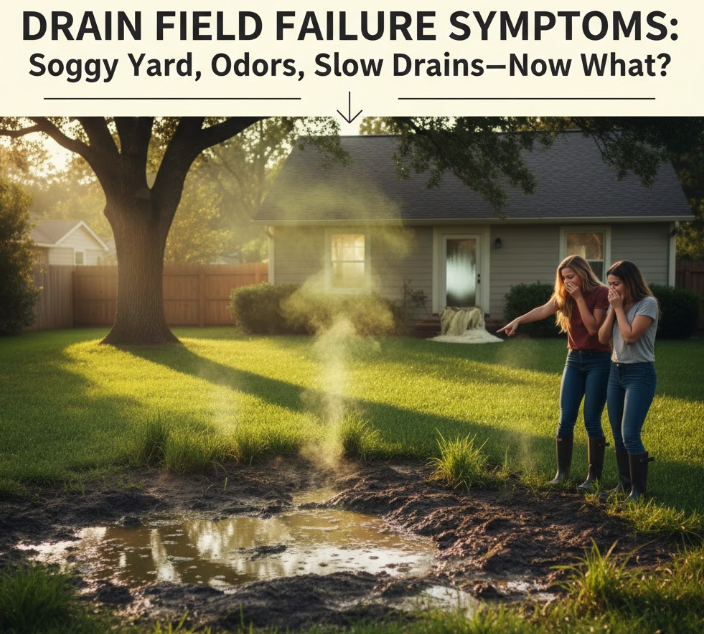
If your yard is soggy, your drains are slow, or you’re noticing septic smells outside, the first thing most homeowners worry about is the drain field — and for good reason. In the Pacific Northwest, heavy rain and saturated soil can make drain field issues show up faster, even if the system was “fine” a month ago.
This post breaks down the most common drain field failure symptoms, what they usually mean, what you should do right away, and how to prevent small problems from turning into a full drain field repair.
What your drain field does (and why it fails)
Your septic tank holds solids and sends liquid wastewater (effluent) out to the drain field. The drain field relies on soil to absorb, treat, and disperse that effluent safely.
Drain field problems usually come from one (or a combination) of these:
-
The septic tank is overdue for pumping (solids can move toward the field)
-
Too much water is entering the system (laundry marathons, leaks, guests)
-
The soil is saturated (common in the PNW during long rain stretches)
-
Compaction (driving/parking/building over the field)
-
Root intrusion or damaged lines
-
The field is simply at the end of its lifespan
8 common signs of drain field failure (or saturation)
1) Soggy ground or standing water near the drain field
If the ground stays wet in one area — especially with no sprinkler running — it can mean the field isn’t absorbing effluent properly.
What it can indicate: saturation, clogged soil, broken line, or a field that’s overloaded.
2) Sewage odors outside
A drain field that’s struggling can produce noticeable odors around the septic area, especially after heavy water use.
What it can indicate: effluent too close to the surface or not dispersing correctly.
3) Slow drains throughout the house
One slow sink might be a clog. Multiple slow drains is a system signal.
What it can indicate: restricted flow leaving the tank, saturated drain field, or a developing backup condition.
4) Gurgling toilets or bubbling drains
Gurgling can happen when the system can’t move wastewater efficiently and air gets pushed back through plumbing.
What it can indicate: a downstream restriction or drain field not accepting flow.
5) Toilet flushing changes
Weak flushes, frequent “almost clogs,” or water rising higher than normal can be a sign the system is backing up.
What it can indicate: wastewater can’t leave the home fast enough.
6) Extra green or fast-growing grass over the field
This one surprises people. If the grass over your drain field is greener than the rest of the yard, the soil may be getting extra moisture and nutrients.
What it can indicate: effluent staying too close to the surface.
7) Sewage backup in the lowest drain (emergency)
Basement showers, floor drains, or lowest bathrooms often show problems first.
What it can indicate: the system is no longer moving wastewater away from the home.
8) Problems get worse after rain
If symptoms show up mainly during/after storms, that’s a strong clue your soil is saturated and your drain field can’t breathe.
What it can indicate: rain-driven saturation, poor drainage, or field nearing capacity.
What to do immediately if you suspect a drain field problem
-
Reduce water use right away
Skip laundry, long showers, dishwashers, and excessive flushing. -
Don’t drive or park over the drain field
Wet soil compacts easily and makes absorption worse. -
Avoid septic “miracle” additives
They don’t fix a saturated or failing drain field. -
Call for an evaluation before it turns into a backup
A professional can confirm whether you’re dealing with tank level issues, a clogged filter, a pump issue (if applicable), or drain field saturation/failure.
How drain field problems are diagnosed
A proper evaluation can include:
-
Checking tank levels and condition
-
Checking and cleaning the effluent filter (if present)
-
Looking for surface signs (ponding, odors, lush grass)
-
Evaluating pump/alarm function (for pressure systems)
-
Camera inspection of lines (when needed)
The goal is to find the real cause so you’re not guessing — because the “fix” depends on what’s actually happening.
How to prevent drain field problems (especially in the PNW)
-
Pump your septic tank on a consistent schedule
-
Clean the effluent filter regularly (if your system has one)
-
Space out laundry loads (avoid back-to-back load marathons)
-
Fix running toilets and dripping fixtures quickly
-
Route roof and surface runoff away from the drain field
-
Keep vehicles, trailers, and heavy equipment off the field
Need help with a drain field issue?
If you’re in Snohomish County, King County, or Camano Island and you’re seeing soggy ground, odors, or slow drains, we can help you figure out what’s going on and what to do next.
A Wesco Septic, Inc.
Phone: (360) 668-6561
Email: info@awescoseptic.com
Office: 16607 SR 9 SE, Snohomish, WA 98296
24/7 emergency service available
FAQ
Can heavy rain cause drain field failure?
Heavy rain can saturate the soil and make symptoms show up, even if the field hasn’t “failed” permanently. But repeated saturation and overload can speed up long-term damage.
Will pumping fix a drain field problem?
Pumping can help if the issue is an overfull tank pushing solids/effluent forward. If the drain field is saturated or failing, pumping alone may not solve it.
Is a soggy yard always a drain field failure?
Not always — it can also be surface drainage, downspouts, or a plumbing leak. A septic evaluation helps confirm the cause.